
Agartala, December 4:
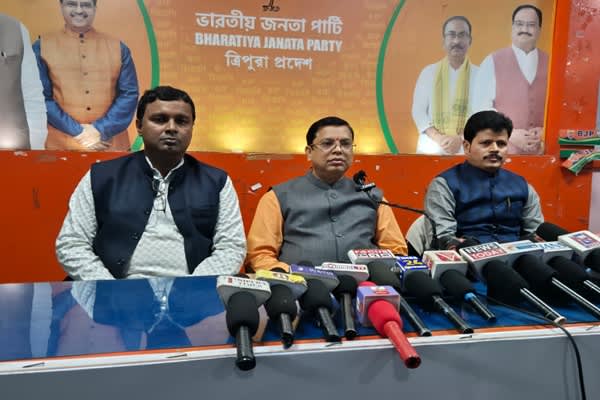
Labour Minister Tinku Roy on Thursday strongly defended the new labour codes introduced by the BJP-led government, asserting that the reforms have brought substantial improvements for workers. Addressing a press conference at the BJP state office in Agartala, he accused Leftist organizations of misleading the public through misinformation campaigns.
The minister was accompanied by MLA Bhagaban Das, Sunit Sarkar, and the BJP State Media In-charge. Speaking to reporters, Roy noted that India’s earlier labour laws—many of which dated back to the British era—were scattered across multiple legislations, causing confusion and inefficiencies. The new labour codes, he said, consolidate these fragmented laws into a modern, comprehensive framework better suited to current economic and social realities.
Highlighting key advantages of the new system, Roy emphasized that the codes uphold the principle of equal pay for equal work, ensuring wage parity across job categories and eliminating gender-based discrimination. He added that the reforms introduce simplified procedures, stronger wage security, and enhanced protection of workers’ rights.
Roy further stated that Prime Minister Narendra Modi’s vision behind the reforms is to end the long-standing “Inspector Raj,” replacing it with a more transparent, supportive, and technology-driven compliance mechanism. Under the new system, facilitators will assist workers and employers instead of functioning as enforcers, creating a more cooperative environment in the labour sector.
The minister also pointed out that the new codes bring clarity to issues such as entitlements, safety measures, and grievance redressal mechanisms, which were previously complicated under multiple laws. These measures, he said, are aimed at boosting worker welfare and strengthening the labour ecosystem.
Concluding his address, Roy dismissed criticisms from Leftist groups as baseless and politically motivated. He reiterated that the new labour codes mark a progressive step toward protecting workers’ interests and ensuring fair and transparent labour practices across the country.