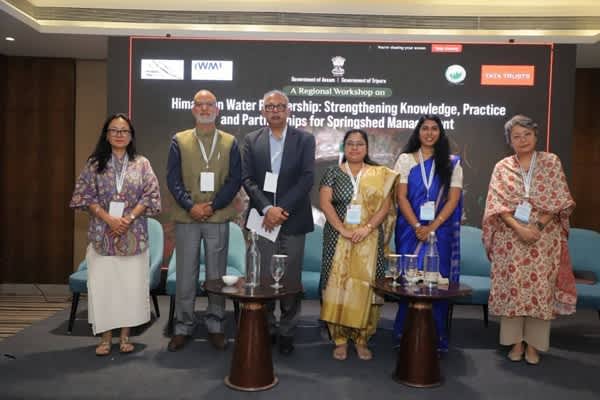

Agartala, June 19: Chandni Chandran, IAS, District Magistrate and Collector of North Tripura, emerged as a prominent voice for sustainable water resource management at the Regional Workshop on Himalayan Water Partnership: Strengthening Knowledge, Practice and Partnerships for Springshed Management. Addressing policymakers, experts, and stakeholders, she called for urgent and coordinated measures to protect the fragile water ecosystems of the Himalayan and Northeastern regions.
Participating in a panel discussion on “Role of Technology, Community in Springshed Management and the Need for an Integrated Policy Framework,” Chandran highlighted the alarming decline of natural springs across the Northeast. Citing recent observations, she noted that nearly 40 percent of springs in Northeast India have disappeared over the past five years, posing a serious threat to water security, biodiversity, and the livelihoods of communities dependent on these vital water sources.
Drawing from her experience in implementing the Springshed Management Project in the Jampui Hills of Tripura, the District Magistrate shared success stories from interventions carried out across 36 springs. She explained that scientific mapping, groundwater recharge measures, and active community participation had significantly improved water retention and helped revive several springs that were on the verge of drying up. According to her, sustainable conservation efforts must combine modern scientific approaches with traditional community stewardship.
Chandran also raised concerns regarding the allocation of national water conservation funds. She observed that a substantial portion of resources under MGNREGA is directed toward discharge zones in states such as Punjab, Haryana, and Rajasthan, while critical recharge zones in the Himalayan and Northeastern regions continue to receive inadequate support. Stressing the importance of upstream conservation, she asserted that downstream water availability cannot be sustained without strengthening ecological protection at the source.
Highlighting innovative grassroots models, she referred to an initiative in Koriya district of Chhattisgarh, where farmers voluntarily dedicate five percent of their land for water conservation activities. She suggested that similar practices could be encouraged nationwide through incentives, subsidies, and policy support.
The workshop, organized by Tata Trust and CML in collaboration with the Governments of Assam and Tripura, concluded with a collective call for stronger partnerships, knowledge sharing, and integrated policy frameworks to restore springs, protect ecosystems, and build resilience against climate change.